

How Is An Atrial Septal Defect Repaired
What Is an Atrial Septal Defect?
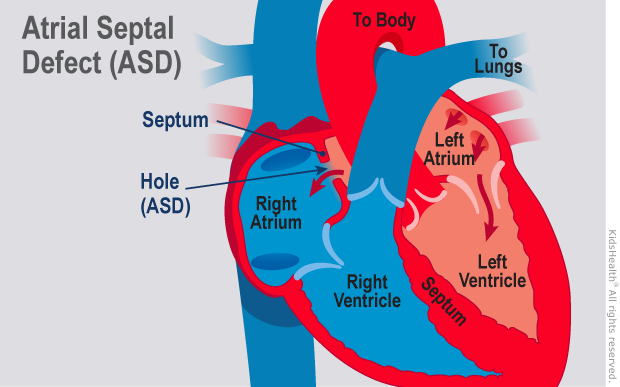
An atrial septal defect (ASD) — sometimes called a pigsty in the heart — is a type of built heart defect in which at that place is an abnormal opening in the dividing wall between the upper filling chambers of the heart (the atria).
In about cases, ASDs are diagnosed and treated successfully with few or no complications.
What Happens in an Atrial Septal Defect?
In an atrial septal defect, there'due south an opening in the wall (septum) betwixt the atria. As a result, some oxygenated blood from the left atrium flows through the hole in the septum into the right atrium, where it mixes with oxygen-poor blood and increases the total amount of blood that flows toward the lungs.
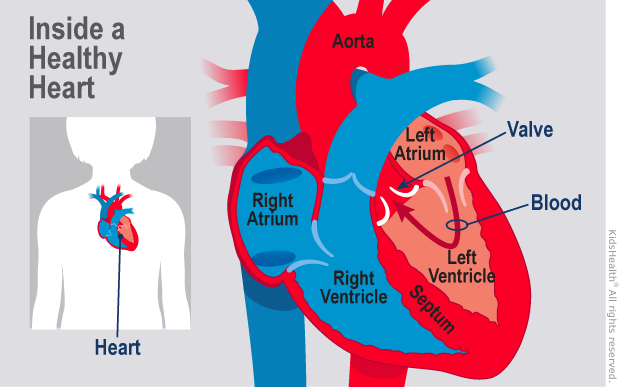
The increased blood flow to the lungs creates a swishing sound, known as a heart murmur. The murmur, forth with other specific eye sounds, oft is the starting time tip-off to a doctor that a child has an ASD. ASDs can exist in different places on the atrial septum and can vary in size.
What Causes Atrial Septal Defects?
Children with ASDs are born with the defect. ASDs happen during fetal development of the heart. The heart develops from a large tube, dividing into sections that volition eventually become its walls and chambers. If there's a trouble during this process, a hole can form in the wall that divides the left atrium from the right.
In some cases, the trend to develop an ASD might be inherited (genetic). Genetic syndromes can crusade extra or missing pieces of chromosomes that can be associated with ASD. Near ASDs, though, take no clear cause. Information technology'due south besides not clear why ASDs are more than common in girls than in boys.
What Are the Signs & Symptoms of an Atrial Septal Defect?
The symptoms caused by an ASD depend on its size and its location. Most kids who have ASDs seem good for you and appear to have no symptoms. Most grow and proceeds weight normally.
Children with larger, more than astringent ASDs, though, might have some of these signs or symptoms:
- poor appetite
- poor growth
- extreme tiredness
- shortness of breath
- lung problems and infections, such equally pneumonia
What Problems Can Happen?
An ASD that isn't treated in childhood can lead to health problems later, including an abnormal heart rhythm (an atrial arrhythmia) and problems in how well the heart pumps blood.
As kids with ASDs get older, they also might be at an increased take chances for stroke because a blood clot could form, pass through the pigsty in the septum, and travel to the brain. Pulmonary hypertension (high claret pressure in the lungs) likewise may develop over time in older patients with larger untreated ASDs.
Considering of these possible complications, doctors usually recommend endmost ASDs early in babyhood.
How Are Atrial Septal Defects Diagnosed?
After hearing the center murmur that suggests a hole in the atrial septum, a doctor may refer a child to a pediatric cardiologist, a doctor who specializes in diagnosing and treating centre disease in kids and teens.
The cardiologist might order one or more of these tests:
- chest X-ray: an image of the heart and surrounding organs
- electrocardiogram (EKG): a record of the heart's electrical action
- echocardiogram (echo): a picture of the heart and the blood flow through its chambers. This is often the primary tool used to diagnose an ASD.
How Are Atrial Septal Defects Treated?
Treatment of an ASD will depend on a child'south age and the size, location, and severity of the defect.
Very pocket-sized ASDs might not need whatever handling. In other cases, the cardiologist may recommend follow-up visits for observation.
Usually, though, if an ASD hasn't closed on its own by the fourth dimension a child starts school, the cardiologist volition recommend fixing the hole, either with cardiac catheterization or centre surgery.
Cardiac Catheterization
Many ASDs can be treated with cardiac catheterization. In this procedure, a thin, flexible tube (a catheter) is inserted into a blood vessel in the leg that leads to the heart. The cardiologist guides the tube into the center to make measurements of blood flow, pressure, and oxygen levels in the heart chambers. A special implant is positioned into the hole and is designed to flatten confronting the septum on both sides to close and permanently seal the ASD.
In the beginning, the natural pressure level in the heart holds the device in place. Over fourth dimension, the normal tissue of the heart grows over the implant and covers it entirely. This nonsurgical technique leaves no breast scar, has a shorter recovery time than center surgery, and ordinarily needs just an overnight stay in the hospital.
In that location'south a small risk of blood clots forming on the closure device while new tissue heals over it, then kids who had a catheterization have a low dose of aspirin for 6 months later the procedure. Over time, the normal tissue of the heart grows over the device and the aspirin is no longer necessary.
Later on catheterization, a child should take it piece of cake for a few days and might demand to skip gym class or sports practice for a calendar week or two.
Eye Surgery
Sometimes, when the ASD is very large or too close to the wall of the heart, a device cannot be safely used and middle surgery is needed to shut the defect.
If your kid has surgery, he or she volition get general anesthesia and won't feel pain or be able move around during the surgery. The surgeon will brand a cut in the chest, then stitch the hole in the atrial septum closed or sew a patch of manmade surgical cloth (such every bit Gore-Tex) over information technology. Somewhen, the tissue of the center heals over the patch or stitches, making the area smooth and virtually normal in appearance.
Kids normally tin get out the hospital iii to 4 days after surgery, if there are no problems. The beginning few days at home, your child should relax in bed or on the couch doing quiet activities such as reading, sleeping, and watching Goggle box. Your doctor will let you know when your child can become dorsum to school.
Information technology takes about 6 weeks for a chest incision to heal. If in that location are no other problems and the cardiologist say information technology's OK, your kid should exist fully recovered and able to return to normal activities.
Heart surgery does leave a permanent scar on the breast. It will exist sore at first, so the medico might prescribe a hurting reliever, or recommend acetaminophen or ibuprofen. Your child might feel numbness, itchiness, tightness, or burning around the cutting.
For 6 months following catheterization or surgical closure of an ASD, antibiotics are recommended before routine dental work or surgical procedures to prevent infective endocarditis (an infection of the inner surface of the heart). When the heart tissue has healed over the closed ASD, nearly patients no longer demand to worry virtually the risk of infective endocarditis.
Your md will talk over other possible risks and complications with yous before the process.
Later on their ASD is closed and they've had enough of time to heal, nearly kids have no further symptoms or issues.
What Else Should I Know?
In the weeks later on surgery or cardiac catheterization, the cardiologist will check on your child's progress. Your child might accept another echocardiogram to make sure that the center defect has airtight completely.
Most kids recover from treatment quickly, and will just need regular follow-up visits with their cardiologist. You might even notice that within a few weeks, your kid is eating more and is more active than earlier surgery.
However, some signs and symptoms might indicate a problem. If your child is having trouble animate, call the doctor or go to the emergency section immediately. Also call the doctor if your child has any of these symptoms:
- a bluish color around the rima oris or on the lips and tongue
- poor ambition or difficulty feeding
- failure to gain weight or weight loss
- listlessness or decreased activity level
- a lasting or unexplained fever
- increasing pain, tenderness, or pus oozing from the incision
Having your child diagnosed with a center status can be scary. But the adept news is that your pediatric cardiologist will be very familiar with ASDs and how best to manage the status. Almost kids who've had an ASD corrected continue to live healthy, active lives.
The care squad is there to support you and your kid. Exist certain to inquire when you accept questions.
You likewise can find more than data and back up online at:
- The American Heart Clan
- Nemours Children's Health

Source: https://kidshealth.org/en/parents/asd.html
Posted by: johnsonmights.blogspot.com
0 Response to "How Is An Atrial Septal Defect Repaired"
Post a Comment